2026 Book Repairs
Posted
13th October 2026
in blog, Blogs & News, Literature
For a number of years we have sent a few books from The House to a bookbinder to be professionally repaired. Owing to their age, there are many volumes on the shelves of The Study which are becoming fragile and as we want staff, volunteers and visitors to be able to handle books they are interested in, it is important that we take care of them so that they remain accessible.
Each year we aim to select a variety of titles to reflect different aspects of our book collection, such as something by a friend or acquaintance of Elizabeth’s, a literary magazine, something church related, as well as always something by Elizabeth herself. This year we were able to repair six titles (seven volumes), thanks to the generosity of Friends of Elizabeth Gaskell’s House.
We have quite a sizeable collection of literary magazines, almost all in bound annual volumes. These were important in Victorian times for providing recreational and informed reading material for a growing number of readers. They became an important source of income for publishers, as well as offering an opportunity for writers including many women, to earn money. Elizabeth was very alert to the range of magazines available at the time she was writing. She had grown up reading magazines such as Blackwoods and The Quarterly Review. Her first stories appeared in a magazine published by her friends The Howitts. In 1850 Charles Dickens approached her to contribute to his new magazine Household Words. Last year we restored Vol 1 of this.
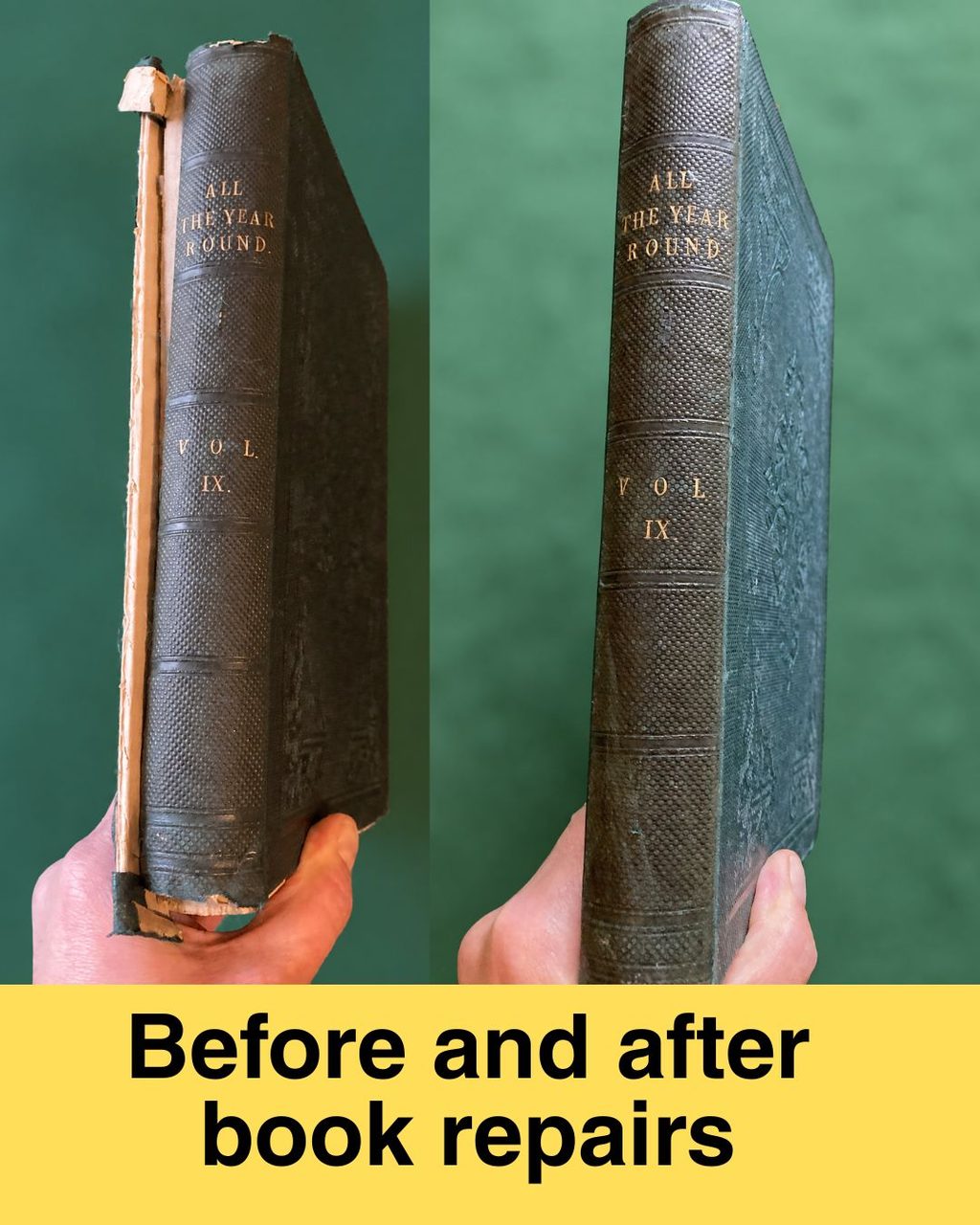
This year we sent two magazines. All The Year Round Vol 9 1863 which includes chapter nine of Elizabeth’s A Dark Night’s Work as the opening story. We only have two bound volumes of this magazine, Volume 1 and this one. Of course we would love to find volume eight which contains the earlier chapters of A Dark Night’s Work.
All The Year Round was the successor to Dicken’s Magazine Household Words. It eventually reached a circulation of 300,000, 8 times the largest number achieved by its forerunner. Each weekly issue contained an instalment of a novel, a poem, 3-5 articles designed to appeal to a general audience and occasionally a short story. The first issue contained the opening chapter of A Tale of Two Cities.
In September 1862 Elizabeth had sent a letter to an unnamed publisher in the USA, saying that she intended to publish a story, then called A Night’s Work in All The Year Round, She said ‘it will occupy 10-12 numbers.. After it is completed… I have the right to have it republished here in one volume. Are you inclined to make any offer to me for the power of republishing it in America? If so perhaps you will be so kind as to write by return steamer…’. This publisher may have been Harper and Brothers of New York who published several of Elizabeth’s works, sometimes without her permission.
As well as A Dark Night’s Work, All The Year Round later published The Grey Woman, also Wikie Collins’ The Moonstone and A Woman in White. In 1868, Dickens made his son Charles Dickens Jr sub-editor.
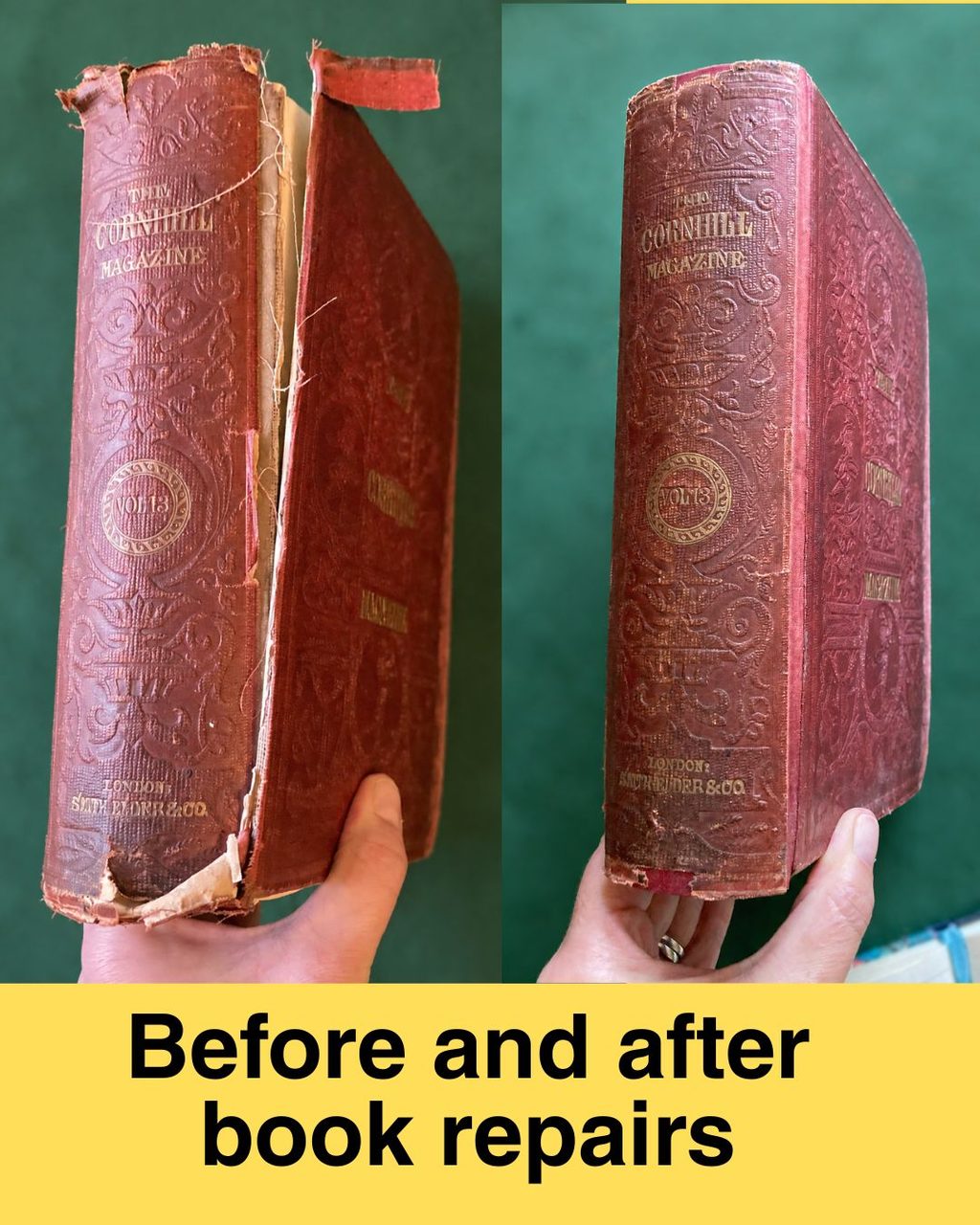
The second magazine we chose to send was the Cornhill Magazine volume 13 1866. This volume contains the concluding chapter of Wives and Daughters published posthumously in January 1866 after Elizabeth’s sudden death the previous November. This volume also includes a long section of Armadale by Wilkie Collins.
The Cornhill Magazine was a monthly magazine founded by George Murray Smith in 1859 and first published in 1860.Thackeray was editor from 1860-1862, on condition that he would only have editorial duties and that Smith would take care of the business arrangements. Thackeray resigned after two years and was succeeded by an editorial committee composed of George Smith, Frederick Greenwood, GH Lewes and later Edward Dutton Cook, a drama critic and author. The Cornhill aimed to provide high-quality literary content, including serialized novels, short stories, and essays on diverse subjects. It was known for its safe, inoffensive content and featured illustrations by distinguished artists such asGeorge du Maurier, Edwin Landseer, Frederic Leighton, and John Everett Millais.
Next on the list was Lancashire Stories by Ben Brierley Published by Abel Heywood & Son, Manchester in 1882. In The Study we always try to tell visitors about William Gaskell’s interest in Lancashire dialect. He used to listen to people singing or reciting dialect poetry and then try to rewrite it so that the poems could be read by readers able to understand the authentic voices. We believe that William would have advised Elizabeth when she was writing dialect as she did extensively in works such as in Mary Barton and North and South.
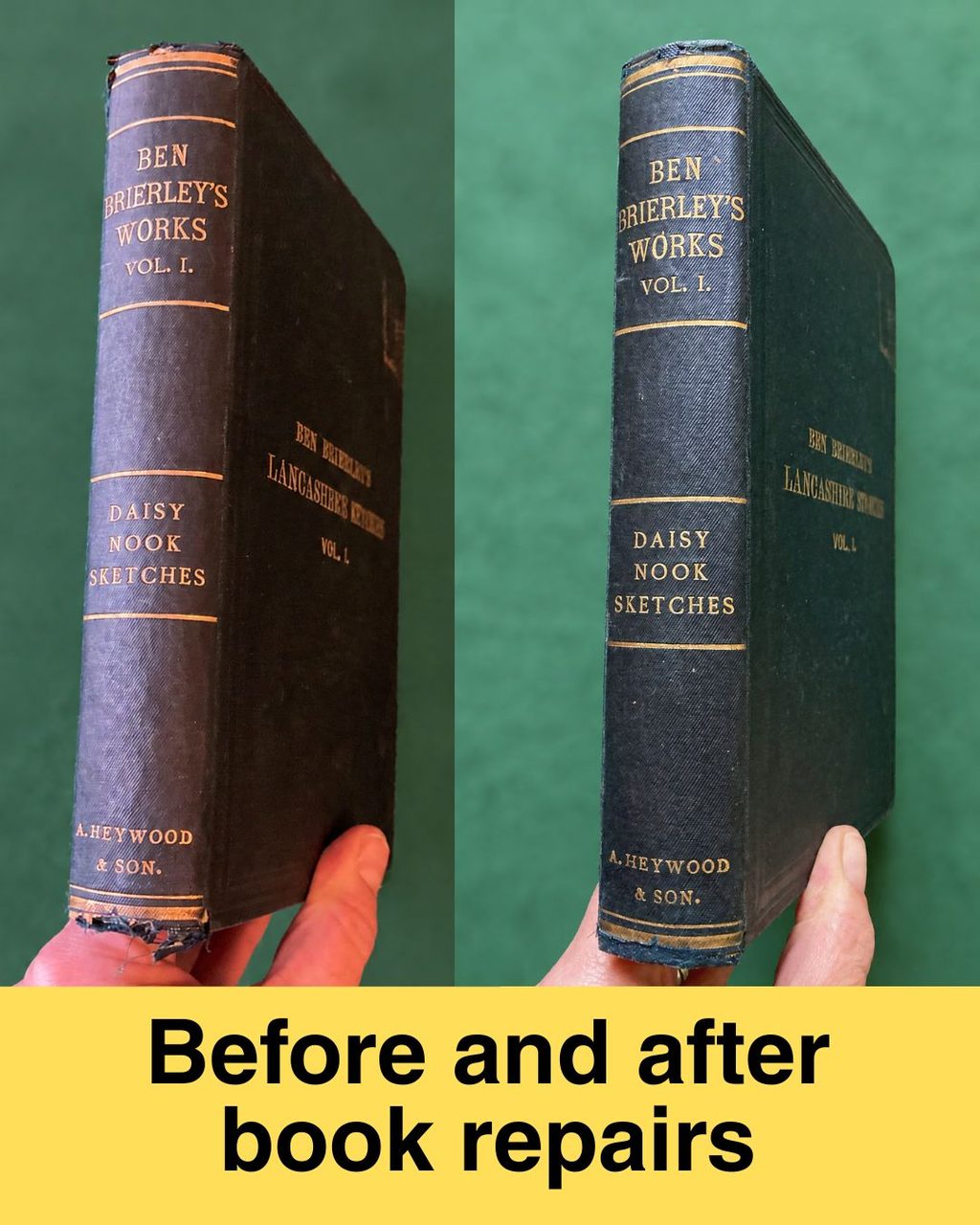
Ben Brierley was an important 19th century writer in Lancashire dialect and we have several vols of his Lancashire Stories published by Abel Heywood in Manchester. It is interesting to note that Heywood treated access to print as a political right and defied the law to keep literature cheap for working people. This year we sent volume 1 of the series, printed on cheap quality paper, for repair .
Ben Brierley 1825-1896 was born in Failsworth, son of a hand-loom weaver who had fought at Waterloo and was present at Peterloo. Ben rose from mill worker to author, journalist, and politician. Largely self-taught, he wrote humorous stories in local dialect about Lancashire life and people. His first published story appeared in the Manchester Spectator and was well-reviewed by the Guardian and other papers. He was a founder member of the Manchester Literary Club which promoted working class literary culture; in 1863 was sub-editor of the Oldham Times, and in 1869 he began Ben Brierley’s Journal, a weekly dialect periodical. In 1875 he was elected to Manchester City Council and served for six years. He died on 18 January 1896 and is buried in Harpurhey Cemetery.
Brierley had a wide circle of readers and admirers. William Gaskell’s interest and support of Lancashire dialect writers suggest he is likely to have known of Brierley and his work.
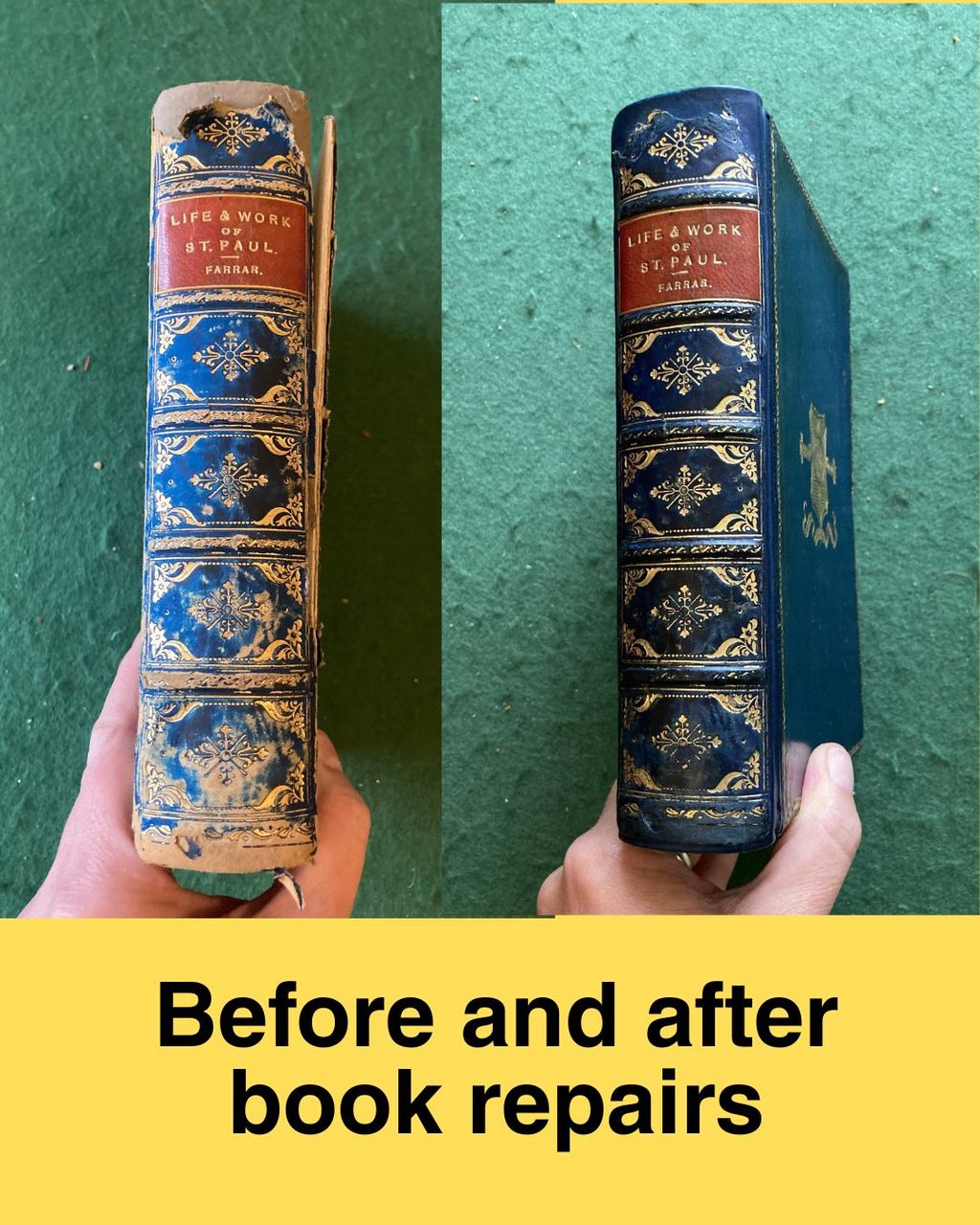
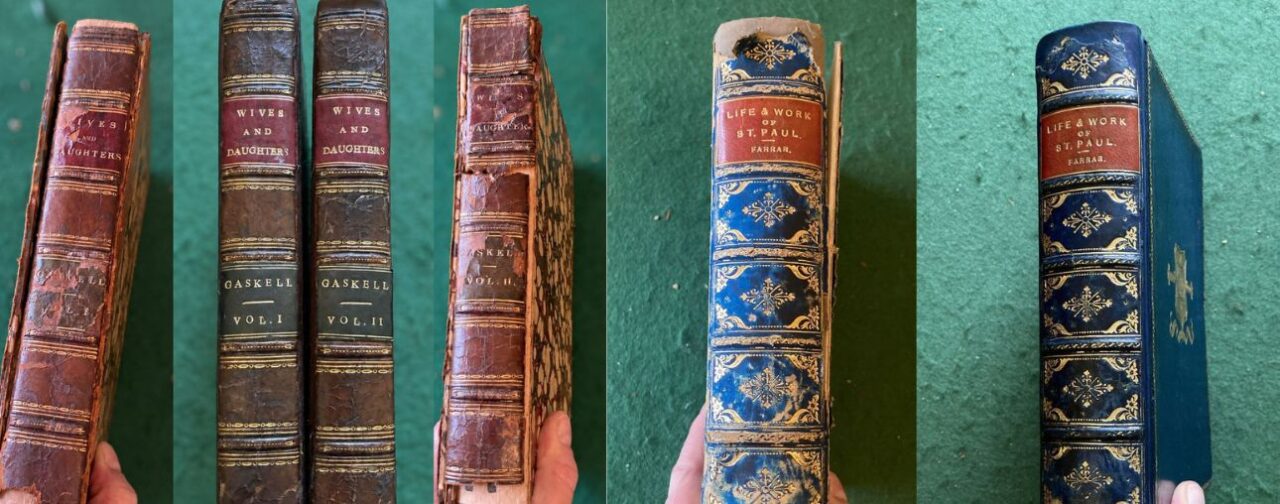
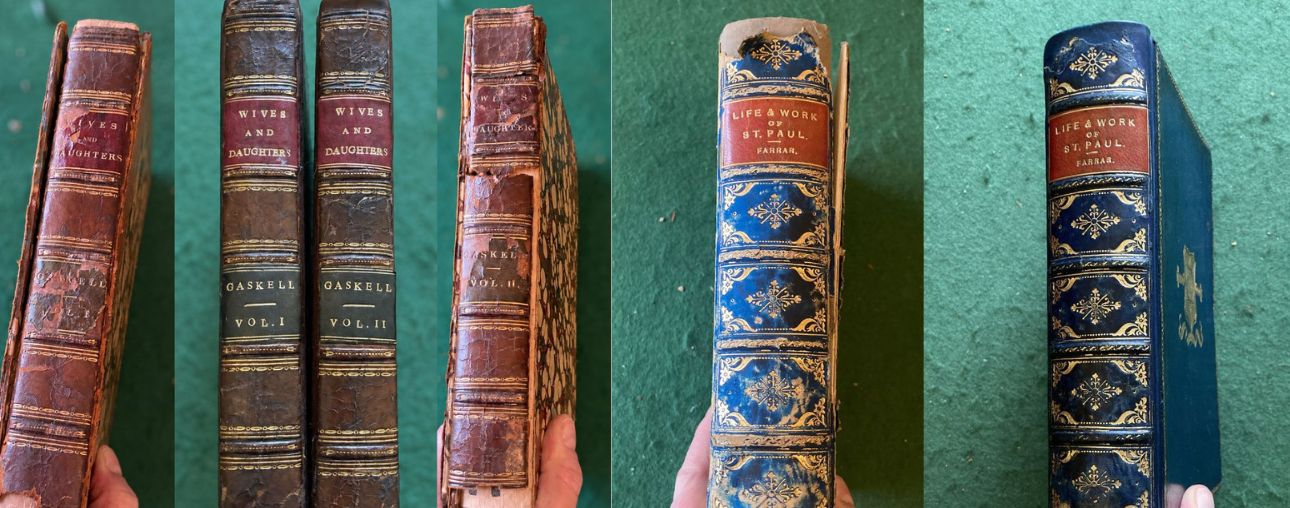
Our religious work this year was Frederick W Farrar’s The Life and Work of St Paul Popular edition Cassell 1895. This title, first published in 1879 , is listed in the Sale Catalogue of items auctioned from The House in 1914, suggesting William owned a copy, though an earlier edition.
Farrar was a prominent C of E clergyman, author and school teacher From 1871 -1876 he was chaplain to Queen Victoria. In 1882 he was a pall bearer at Charles Darwin’s funeral. He became a prolific author, writing among other things many school stories including the well-known Eric or Little by Little. This was published in 1858 as a moral tale and became a publishing sensation at the time.
The Life of St Paul was a popular narrative-driven account of Paul’s life. It circulated in parish libraries, Sunday‑school libraries, middle‑class homes and clergy study groups. It became a standard reference for lay readers who wanted a vivid, readable portrait of the apostle. There is no evidence that Farrar ever met William Gaskell but their interests and circles overlapped, so that it is certainly possible. He definitely knew the author Charles Kingsley, who corresponded with Elizabeth Gaskell.
Our copy, which once belonged to Queen Elizabeth School in Barnet, has a good quality blue leather binding which was almost completely detached and the spine was very worn. It now looks much more robust.
Something of a curiosity, we sent a tiny but old volume Lettres Choisies de Mme de Sevigné Vol 1 Pub 1810 in Paris by Bossange et Masson. We have both volumes of this 2 volume selection in French. The second volume is in much better condition than the first which now has a smart new spine. Publishing House Bossange et Masson was unusual for its time as it specialised in exporting French books internationally. A London branch opened in 1814, so I wonder if Elizabeth acquired this in Paris or London?
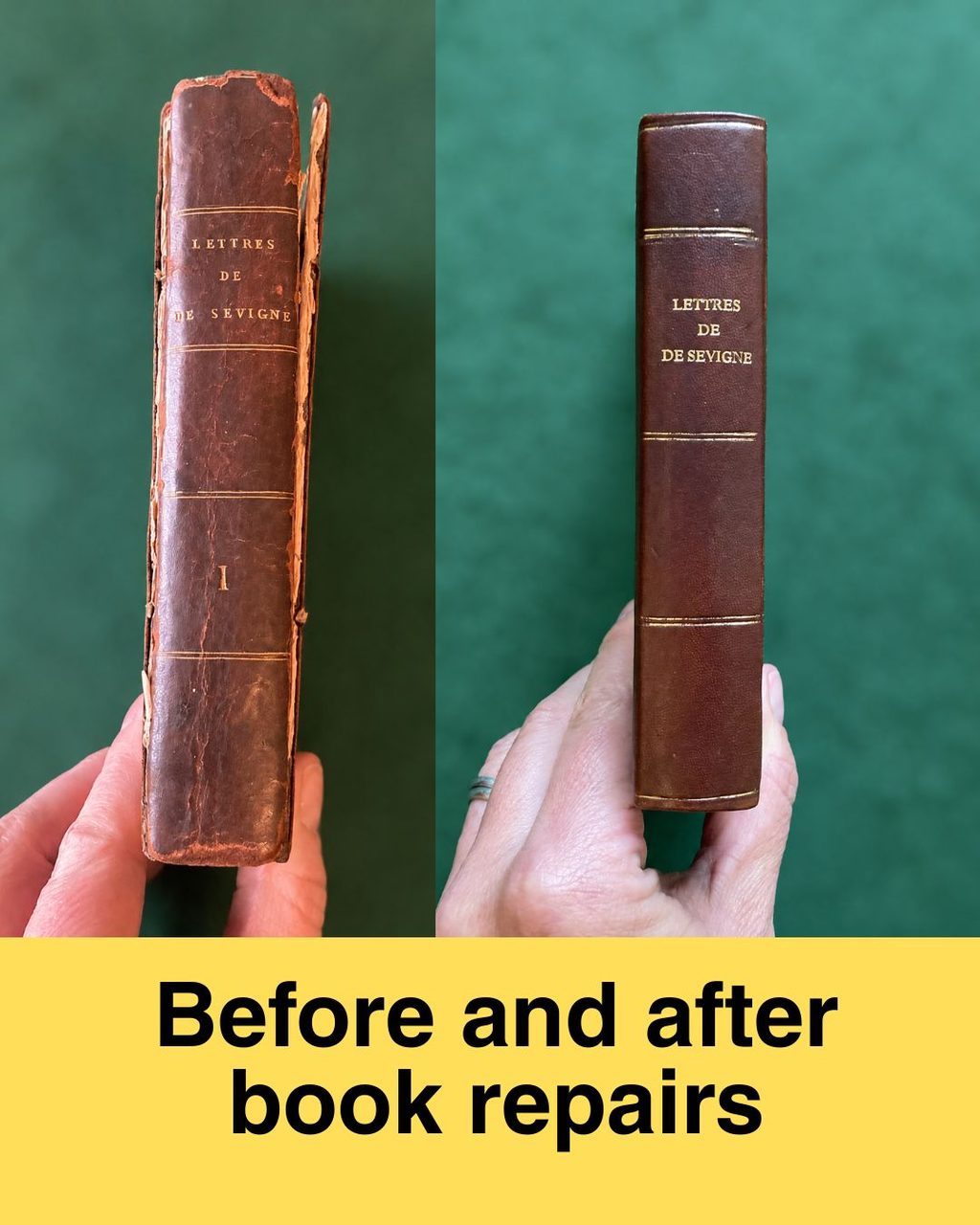
Mme de Sevigné1626-1696 wrote1000s of letters describing her life in France during the time of Louis XIV. She became one of the great icons of French Literature, known for the letters mainly written to her daughter over a period of 30 years. They were first published in England, in translation in 1726.
Ours is a French edition and we know that Elizabeth was able to read and speak French and was a regular visitor to France. We also know she read and admired the work of Mme de Sevigné. In 1861 she was planning a series of articles on French Life for All The Year Round, centred on the life and times of Mme de Sevigné. These were never written, but according to Uglow, an enjoyable research trip/ holiday to Normandy (sic: Mme de Sevigné actually lived in Brittany) provided relief from Manchester’s misery. In 1863 she wrote to George Smith saying “ I have ever so many things begun, Life and Times of Mme de Sevigné more in my head than out of it; but I think it will be good”
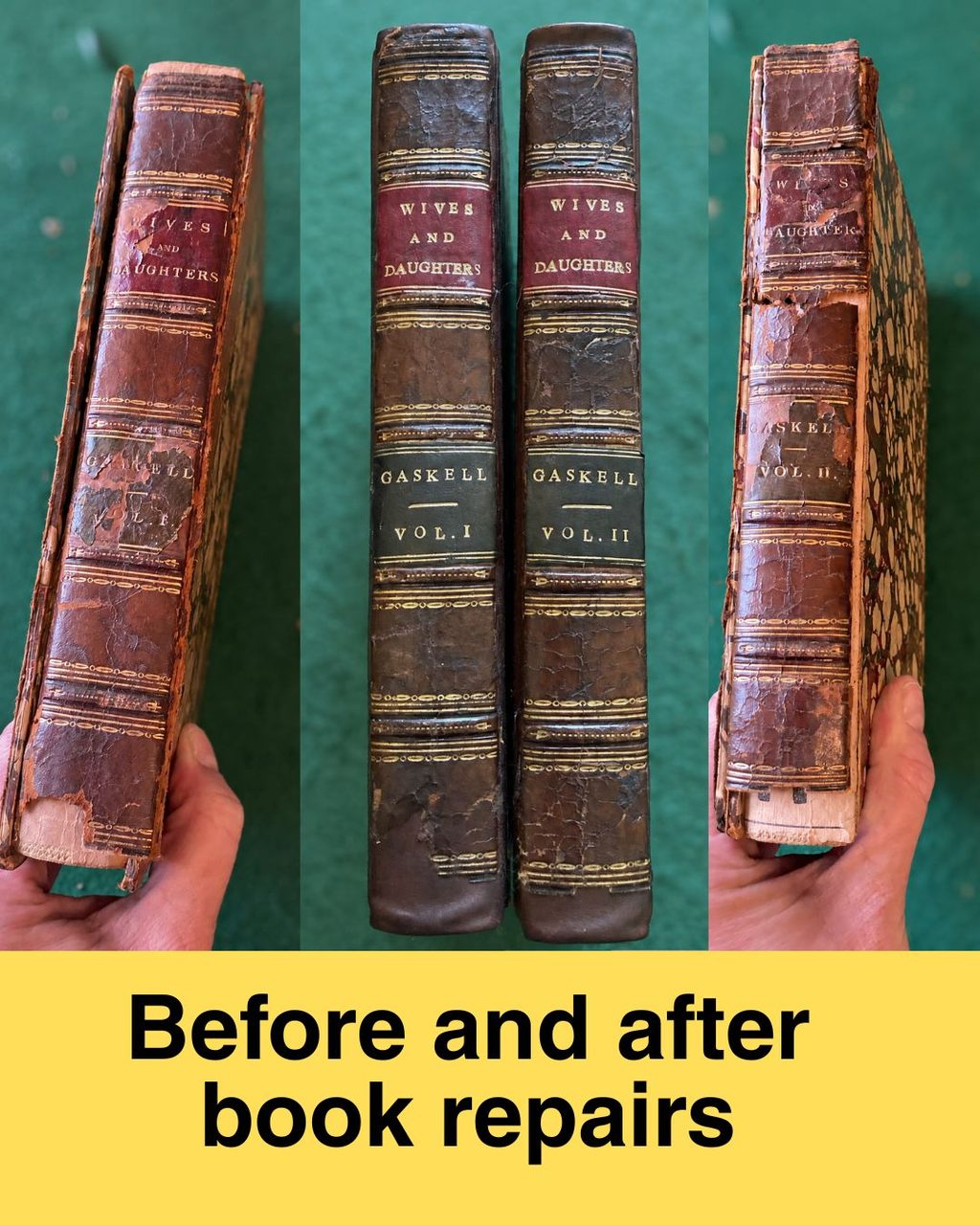
Finally we chose to send a two volume First edition of Wives and Daughters by Elizabeth Gaskell, published by Smith, Elder in 1866.
This was Elizabeth’s final novel which was unfinished at her death. It was first serialised in monthly instalments in The Cornhill magazine from Aug 1864 to Jan 1866 then published in book form by Smith, Elder later in 1866. Letters written by Elizabeth at the time she was writing Wives and Daughters reveal the effort she was required to make to keep up with monthly deadlines, saying ‘ I could make it longer I have so much to say yet: but Oh! I am so tired of spinning my brain, when I am feeling so far from strong.’
In May 1865 she was ahead with her story, having written up to the August edition of Cornhill. Then she became distracted by the potential purchase of a house in Hampshire and by August she says that she is ‘so badly behind in Wives and Daughters., All these worries about Alton do so incapacitate me from writing’. And there she dies in November with the novel not quite complete. Frederick Greenwood, then an editor at The Cornhill, wrote some concluding remarks and rounded off the story as he hoped its author would have wished.
Although it is a First edition, I am unsure whether or not the brown board covers of our copies are original, as research suggests it was originally published with green cloth covers. Many copies for sale online say rebound, suggesting that the original binding was not very durable.
This is one of several items donated to The House by Nancy Weyant, a USA based bibliographer. Nancy has compiled an exhaustive bibliography of Elizabeth Gaskell’s work and sources and so has made a huge contribution to Gaskell scholarship. One of these volumes still includes a bookseller receipt from Pittsburgh. Our copy of Wives and Daughters therefore has history of travelling backwards and forwards across the Atlantic, which I think Elizabeth would have relished.
Article by Jane Mathieson, Volunteer at Elizabeth Gaskell’s House